Thursday, March 12, 2015

Pathfinder by Orson Scott Card Book Review

So, at long last, I decided to crank up my Drum and Bass channel on Pandora and finally get this review finished. 

Rigg is a pretty ordinary kid from the outside. In fact, he's of the lowest social standing there is, a "privick" from far upriver who makes his living with his father hunting and selling furs. But Rigg has one ability that makes him extrodinary: he can see the paths. The paths of all who have ever been, all the animals, the people, the insects, he can see their paths through space and time, reaching back thousands of years. He's been able to prevent the death of himself and his father on a few occasions, but beyond that, Rigg doesn't see much purpose for his "gift". 

Then that changes. Suddenly things begin to spiral faster than Rigg thought possible, and he realizes that his gift may not be entirely useless after all. In fact, with the help of a few friends, it may even have the ablity to change the world...both in the present, and in the past. 

Review: 

Many sci-fi lovers are already familiar with the name Orson Scott Card after his ingenius book Ender's Game, following the journey of a young boy destined to win an intergalatic war against an alien race. However, in Pathfinder, Card changes direction just a bit, moving away from the Sci Fi genre (while still including sci-fi themes) and more towards the Fantasy genre. Then he takes on a dangerous theme in terms of writing: time anomoly. 

Card himself adknowledges in the authors note that he's decided to "embrace paradox." Gee, thanks a lot. True to his word, Card takes his time explaining every move the characters make when playing with the time space continuum, making this book feel, in a lot of ways, less like a novel and more like a science fiction textbook. His characters, playing the part of the teachers, debate back and forth every step on the way about what they are doing and what the consequences will be, and despite the fact that their conclusions make no sense whatsoever to them or the readers, they plunge head first into space-time (quite literally, you'll find) and do the impossible, not only travel back in time, but manipulate it. Card's genius explains how things often taken for granted in sci fi/fantasy can be explained by time anomalies. Invisibility? Just jump forward a few seconds. "Super speed"? Just accelerate your brain power to where you're faster and more alert than your compainions, then use that ability to go back in time. In this book Card becomes, in a way, a professor of Science Fiction. He's been around the block a few times, and now he's going to explain for us every step of the way why time can be an important part of science fiction that is rarely explained or understood. 

Card is clearly a genuis, and definately deserves credit for his absolutely brilliant concepts surrounding everything we know and enjoy about the genre he writes in. However, this book is not without fault. Far from it, in fact. While the genuis and concept are definately there, the story that is applied to them is terribly underwhelming. Ultimately, Card's mistake lies in that the story does not have a purpose. What it lacks is a character who can challenge our protagonist, pose a threat to him. Rigg and his family have been given extrodinary powers, but to do what with? Who has the ability to pose a challenge to Rigg? Ultimately no one, which makes the story a slow and tedious read with little development along the way, unless of course you take it this series as it seems to be: again, a textbook on sci-fi/fantasy and nothing more. 

And lets not even get started on the dialouge. There is just so much of it. As I said earlier, eighty percent of the book is filled with dialouge of the characters trying to figure out why the heck time travel is even possible and how is works, going back and forth, in a loop, then back again, trying to understand what the consequences will be of any one move they make. Will they disappear? Forget why they even time travelled in the first place? Annoy their readers? Beats me, and them apparently, because in the end they decide that the English language was only created for one time, the present, and trying to explain time is pointless. Unfortunately, they only figure this out after boring most readers for six hundred pages with their back and forth arguments. Personally, I found the dialouge a bit bittersweet. I love that I was able to finally wrap my mind around certain parts of the time space continuum, but disappointed that that was all the depth the story had. No riveting plot twists, no real, difining characters, just time, science and dilouge.

Any way you look at it, Pathfinder is pure genius in concept, but very disappointing in story. I will be finishing the series, because the brilliance of finally having time anomaly explained has captivated me, but since the story and characters were so underwhelming,  I'll be reading a few other series before returning to this one. Overall, if you're a die hard sci-fi/fantasy fan, writer, or thinker, you will probably benefit form "studying" this series (again, textbook), but if you read for the story, the legendary fight between good and evil, characters that make you laugh and cry, then you may not find what you're looking for here. 

Rating:

3 out of 5

Thursday, February 26, 2015

Why do things have to be so freaking complicated??

I'm currently reading Orson Scott Card's book Pathfinder. 

There's a lot of good and bad to be said for this book, but the primary thing that has grasped my attention is it's fresh look at the world of Sci-Fi/Fantasy and the elements of it that we take for granted, for example, supernatural abilities. In the theory of Card's book, the anomalies that we normally percieve as "super powers" like super speed and invisibility can really be explained by time anomalies. Ultimately, they are all explained by scientific theories about time. For example, by skipping moments in time, since there is more space in atoms than there is matter, one can turn invisible (trading speed for stealth, unfortunately, since skipping time would slow down the Invisible considerably). Super speed can be explained by the speeding up of the mind or the slowing down of the world. 

And if you think that sounds complicated, with til you get to time folding. Or time travel. You haven't even stratched the surface of what Card has in his mind's eye here. 

This book, more than anything else, forces me to think about things I wouldn't normally think about, extending my mind to places I really don't like going. Even though Card makes his theories understandable, this series is, more than anything, a harsh reminder of just how big, fantastic, and freaking complicated the world is. 

On one hand, this really frustrates me. As Sherlock of the BBC once said, "I don't know. I don't like not knowing." One of humanities greatest qualities is their desire to know, to explore, to understand, so in that respect, this really ticks me off. Trying to wrap my mind around something that is so far above humanity we could never comprehend leaves me disappointed in my own insufficiancy. Even people like Orson Scott Card, as genius as he is, can only create theories. Complete underderstanding of time is a height I don't believe we'll ever reach, at least not in my lifetime.

But on the other hand, that's okay. In the words of Hank Green, "I am a towering mountain of ignorance. I don't know." Not knowing is both a beautiful and torturing thing. Perhaps it's best defined like that; beautiful torture. We will never know the ins and outs of time, never reach the outer reaches of the universe, will never understand the many mysteries of life, but that's partially what makes life beautiful, that we're going to continue to try to find out, and as we do will grow closer and closer to the creator who does understand the many, many things that we don't. He created them, after all. The Bible says that a day is like a thousand years to God, and a thousand years like a day (2 Peter 3:8) and that one day he will abolish all this timey wimey stuff once and for all and replace it with eternity, and then none of this will even matter.

So yes, I'm not afraid to admit that I am a towering mountain of ignorance, foolish and stupid. I DON'T KNOW. Life is too freaking complicated for a dumbarse like me to understand it, but that's okay. Because I know the one who does.

And that's all that matters. 

Monday, February 23, 2015

Monsters, Mazes, and....what the heck?!

I'm not entirely sure what I expected when I picked up The Maze Runner for the first time. 

I came a bit late into the hype over the series, as I do with most popular books. In fact, they had already released the trailer for the Maze Runner movie by the time the book had worked it's way through the forty-some library requests to get itself to me. The commercial looked promising enough and I was excited to get into the series, and I must say I was very impressed. James Dashner took an epic concept that goes back to Ancient Roman literature and transformed it into a exquisite sci-fi story that included a plot that never stopped twisting and turning. Although I was impressed, the first book definately wasn't complete. Even so, I found myself a bit worried about the sequel, The Scorch Trials. After the brilliance of The Maze Runner I was afraid the concept would be lost upon beginning the sequel, but again, I was not disappointed, nor could I bear to put it down as the plot thickened in every way possible. The original brilliance of Dashner's opening book to the trilogy extended all the way through the books and never ceased to amaze me. 

Dashner's ability to tell a believable story that excites and captivates is something that is lost upon many authors of his genre. Despite it's popularity, dystopia style stories can be difficult to create and tell, especially original dystopias. Often dystopia becomes it's own concept that is copied over and over with slight variations to story and characters. While the original concept of The Maze Runner is similar to a few other dystopia books, it develops into a story that I believe is one of the few truely "original" dystopia stories that has been put to paper in recent years. Many people, when refering to the plot of a book, movie or teli show refer to it as a "roller coster." The Maze Runner is exacly that. New bends, twists and loops hide behind every corner, jolting the rider back and forth so that, although they have countered many sharp turns, are never ready for the next one. Dashner weaves together brilliant story with epic plot twists that build upon each other and never stop doing so until the book is closed. 

While Dashner is a brilliant storyteller, one thing his series lacks (for the most part) is really solid characters. While his character development is good, the characters themselves are a bit dry. Dialouge is similar, but not nearly as much. In every Dashner book I've read so far (The Maze Runner Trilogy, Eye of Minds, Rule of Thoughts) it seems to prove true that he focuses mainly upon the story and less upon the characters that live in his concept. 

While The Maze Runner Trilogy has no moral, per se, the series ultimately demonstrates how friendship and hard work can get someone through the worst life has to offer, even being thrown into a maze with nothing but a few supplies and a ton of monsters. It also tackles the very difficult question of, "Does the end justify the means?" Ultimately, it's up to the reader to decide for himself if the controversial actions of "The Creators" can be justified in the name of the greater good (may even be worth a blog post in time), but if point made in this series is unarguable, it's that people with good intentions, with no one to hold them accountable, can be corrupted and eventually fall far away from their original goals.

The Maze Runner Trilogy is possibly the most brilliant modern dystopia I've read to date. While characters aren't everything I like my protagonists to be, the concept of both the story and the antagonists are downright brilliant, and I'd definately recommend it to anyone looking for something fresh in the world of dystopia and science fiction. 

Rating:

4.5 out of 5 stars. 

Wednesday, January 14, 2015

Real Talk: Distractions

Blarg. 

That's all I've really had to say about the last few days. I'm sure there's a word out there to describe the last few days but right now blarg is working fine. I don't even know what it means, I just know how it feels. Maybe I'll google it later. 

The last few days have just been blarg.  I've been held up on my documentary project (which I'll have out soon, Lord willing) due to car issues, so I'm stuck on that project. In the meantime I have a library book that's due when I haven't even finished the one I've been trying to read since December, and then there's school, completing the tremendously boring cycle of life. It's the cyyycle of liiiiife.....

That's not the point though. The point is it always feels like I am distracting myself. There are highlights in life when we aren't living the boring routine and are instead doing something fun and/or crazy but when examined closer those are really just distractions too. Distractions from what? I don't know, life maybe. Maybe we just want to distract ourselves from the chore of being alive. Sometimes these distractions are fun, sometimes they aren't, but there is always some sort of distraction to keep us at least slightly interested in something other than just being alive. 

But ultimately that's all the cycle is: distractions. In the end they are meaningless chores that spend our time, making us feel like we've accomplished something when really we haven't accomplished anything of real worth. So the question is what are the things that aren't distractions? What few things can we do that actually mean something?

I think that's the purpose of religion in the world, people striving for something more than the daily system. People striving for that more-ness that will make them feel like they've actually done something worth while, but religion eventually becomes a distraction as well. I'm ashamed to say that my beliefs often have turned into nothing more than distractions. I often lose what makes my time with God worth meaning and have replaced it with empty distractions, making me feel like I've done something, when in reality it's all just hay and stubble. 

I don't really feel like going any deeper than that. I've already given my brain enough to chew on.  

Wednesday, December 17, 2014

Ramblings: Main Characters, Integers and Divergence

Every good novel has a main character. Fact. If the novel does not have a main character the novel normally sucks. Often the "main character" of a novel is the character who's point of view the novel takes place in (Hunger Games, Percy Jackson), however there are times when the main character in a novel isn't given a viewpoint (The Book Thief, Fault in our Stars). So what defines a main character? What makes a character the main character? I'm sure there are many explanations that people could come up with but to me the main character is the character that can do something no one else can do. Be it something small, like knowing the power of words, or something large, like being the savior of the physical universe. 

So what's my point? I want to talk about the Divergent Trilogy, specifically about the main character of that series. 

If you haven't read the entire Divergent Trilogy, STOP READING NOW! MAJOR SPOILERS AHEAD!

Divergent, on the surface, is the story of a girl who comes of age, must choose her destiny, and falls in love with an incredibly attractive young man named after the number Four. Sounds like the average young adult novel, right? Totally cliche. But not so fast. The first book might give this impression, maybe even the second, but by the third installment in the series I noticed something interesting happening. Tris, who many may think of as the "main character" doesn't really possess a quality that no one else has. She's Divergent, but as we find out in Insurgent there are actually tons of Divergent people. She posseses the quality of three factions where most Divergents posses only two. I guess that's different, but still, nothing that can change the story. It puzzled me for a while, then it hit me. Duh, I thought, Tris isn't the main character! The more I thought about it the more obvious it became. So who is this main character? I may be wrong, but I really don't think I am. I think it's Four, better known as Tobias. Now, to make my case. 

First of all, Tobias is a much more defined character than Tris. He has a history, scars that will never heal. He knows pain first hand, and he understands what risks should be taken and which should not. To further this point, Veronica Roth has stated that the Divergent trilogy was originally going to be in his point of view, but it just never felt right. So she created Tris.

Secondly, Tobias is really in the center of the story. Jeanine Matthews wants to take over the government run by Marcus Eaton, Tobias' father. After Jeanine takes control, Evelyn Eaton, Tobias' mother, takes the government from her. After that, Marcus and Johanna (leader of the Amity) rebel against her. Then in the middle of it all is Tobias, who is bitter with both his power-hungry parents, his dad for abusing him and his mom for abandoning him. 

Lastly, Tobias has the ability to do something that no one else can do; forgive. In the end, when the memory serum is getting ready to be used on the city, Tobias has to wipe one of his parents memories before they destroy each other. However, in the end, instead of wiping her memory, he forgives his mother. He convinces her that power isn't what she ever wanted, and had the strength to forgive her even after she abandoned him to years of hell with his father. And he singlehandedly ends the war with the power of forgivness. ("I know that sounds like a cat poster, but it's true")

While there is a great deal to be said for Tris' sacrifice (how about that life ruining ending, Divergent fans?), in the end, it was Tobias' strength that saved the city. He overcame his bitterness and hurt, and although the pain would never heal, he chose to ignore it for the ones he loved. I didn't like Divergent much when I first read it, and it's still not among my favorites, but this man is one of my favorite characters possibly ever. He demonstrated what bitterness and anger does to a person, showed the power of forgivness, and despite having lost everything, continued to fight. 

And I think that's pretty darn awesome. 

Wednesday, October 1, 2014

Music Review: x -- Ed Sheeran


Hello my beautiful readers!

I meant to get this to you yesterday, but the charger on my tablet broke, then we watched a movie, which probably deserves a review itself, but before I get off track, here is my review of Ed Sheeran's recent album "x" (pronounced "Multiply").

**NOTE**: I am reviewing the Deluxe Edition of this album, which features an extra 4 songs that, in my opinion, complete the album, as I don't consider 12 tracks a "full" album. **

Ed Sheeran is a bit of a new face in the music industry. With the success following his debut "+" in 2011, he's quickly become one of the biggest acts of the time. And no wonder, with his incredible songwriting and musical abilities, and that falsetto voice you can't help but fall in love with. Plus he has a pretty awesome accent. And now, three years later he releases his second major album, "Multiply".

From the very beginning of this album we see Ed's musical talents in the song One, a beautiful melody about love and devotion, quickly followed by another acoustic song, I'm a Mess, about personal failure in relationships and the desire to make it right ("And though I've only caused you pain/You know but all of my words will always be low/Although all the lies we spoke/When you're on my road/Walking me home/See the flames inside my eyes/It burns so bright/I wanna feel your love").

The album then takes a surprising turn with the hit single, Sing, an irresistibly catchy party song showing a bit of Ed's hip hop side with some rapping on the second verse. Don't is also a bit of a surprise with a bass synth and piano in the chorus, something we hadn't seen yet on this album. The song sings about a fellow singer whom Ed fell in love with, who later cheated on him. The chorus and bridge include a couple surprising use of profanity, cleverly censored with an inhale of breath to avoid an explicit label ("Don't *inhale* with my love").


Then back into the folk/pop ballads we go. In Nina, Ed describes the pain of having to end a possible future relationship because of his job and busy touring schedule, mourning what could have been. Photograph follows in this message as Ed sings about the joy and pain of love. Bloodstream is another song about mistakes ("I've been spinning now for time/Couple women by my side/I got sinning on my mind...How did I get so faded?"). Thinking out Loud and Tenerife Sea are beautiful love songs, the first about Ed's commitment to a life long relationship. The latter sings of a lover who Ed describes beautifully. Both are touching songs about love in it's purest form.

Runaway is about, well, a runaway, fleeing his dad's abuse. He sings in the chorus about his love for his dad, and later the hope that things could change and he could return. Then Afire Love is a song about love in the midst of tragedy.

As if right on Que, Ed decided to get away from the deep stuff for a few songs and goof off with a bit of hip hop, first on The Man which, despite the censored profanities is a pretty meaningful song, talking about, again, a breakup and the depression it brought in the midst of his busy career. Then comes Take it Back, a straight-forward rap song quite a bit like Sing, that is to say, without much meaning; just a song to enjoy. 

The deluxe album concludes with Shirtsleeves, yet another heart touching breakup song, Even My Dad Does Sometimes, and closes with the epic I See Fire, a song from the soundtrack of The Hobbit: DoS about a band of dwarves determined to take their mountain back from the dragon Smaug.

This album oozes meaning, love and heartbreak. Ed is a top of the line musician who has definitely earned his popularity. As a matter of fact I'd go as far as to say he's one of the best overall musicians of our time. There are many positive things here to discuss.  Nina compares how love should be alike to how God sees us ("And you don't even need to worry about your weight/'Cause We can all be loved the way that God made us"), on I'm a Mess and Bloodstream Ed is brutally honest about his mistakes, and his quest for life-long love on songs like One, Photograph, and Thinking Out Loud is definitely something to be praised.

However

Ed just doesn't seem devoted enough to following that quest, as is seen on songs like Sing. The several alcohol and marijuana references along with the profanity (even while being censored) might be a turn-off to many listeners, myself included. There is a lot of good to take from this album, but there is also a large amount of worldly klunk. If you plan on listening to this album, I recommend taking a bit of time out of your schedule and listening to the whole thing in one listening, so you get the big picture, as blurred as it may be. 

Overall Rating:
4 out of 5 stars

Monday, September 29, 2014

The Random Ramblings of, yours truly, Elijah Thompson

Well I sorta felt like writing a blog post.

Not that I have anything interesting to write most of the time. Well, okay, I do, but things work much better in thought than they do on paper. I have way too many unfinished drafts of posts I wanted to write but after reading them over realized they couldn't express my true thoughts. 

Some books that I read just give me a feeling, evoke some emotion in me that I don't recognize. If I considered it long enough maybe I could put a name to it, but as soon as I try to define the beauty of what I feel and think, it loses it's clarity, because let's be honest; unless you're Adam Young, Ed Sheeran, or John Green, it's impossible to fully express your thoughts in words on a sheet.

Which is why blogging is difficult at times. So many books I've read that I wish I could express in this virtual piece of paper just how they make me feel. 

I begin to wish that there was a machine that could translate my thoughts into words, but machines cannot understand emotion, so they would not be able to accomplish it any better than a ceiling fan could. Which leaves only one option for us, and that is telepathy, which is impossible at this time.

The result is a really boring blog. There is a desire in me to blog but a fear that by trying to express myself I will bring the magic in my mind to human standards, turning it into nothing more than empty words and time turned meaningless. 

BUT, but, I can still try. Because fear is something that can be overcome. I will try to express myself in a way that is both coherant and enjoyable to read. 

So let's start over.

My name is Elijah Thompson.

Welcome to the High Desert. 

Tuesday, March 25, 2014

The Rebellion is About to Begin

I recently finished The Hunger Games series by Suzanne Collins.

Normally, I'd write a review on a book series I read, and I still might, but as I sat down to write it, I couldn't find the right words to describe it. I decided to write a blog post and share a little bit about what the series meant to me and what I gained from reading it.

When Collin's wrote the Hunger Games series, much more was on her mind than appealing to the crowds and fame, glory and success for her series. She wrote these books out of concern about where our world was heading and how often in our own little worlds we are blind to what is really happening. With this in mind, the Hunger Games is not an entertaining series. It's troubling. Scary, even. 

Katniss Everdeen is living in a world where the government and rich people are living it up and leaving the rest of the nation to starve, most without even realizing it. The Hunger Games is a spectacle, a reality TV show. I can almost hear a news reporter describing it: "To punish the nation for their rebellion, every year, 24 children of the districts will be thrown into an arena with little to no supplies and be forced to kill each other and, because of the Capitol's grace and mercy (you read right), the last man standing will be crowned victor. Who is the strongest? We'll find out!" 

We think of the Hunger Games as a fantasy, when in reality the world has created it's own Hunger Games many times in history. The Gladiators in Rome, the arenas where Christians would be martyred for their faith. Societies throughout history have created a Panem like world; leave the weak to die while the rest of us live in luxury. 

And in all this, two players of these games decide that enough is enough. Katniss Everdeen and Peeta Mellark, two "Tributes" from District 12 decide to not let the Capitol make them "part of their games". Katniss is about to become the spark that will encourage the districts to stand up for what they know is right. As Suzanne Collins writes in Catching Fire, "At some point, you have to stop running and turn around and face whoever wants you dead. The hard thing is finding the courage to do it."

In many ways, I think that's why people love this series, myself included; because young people are starting to get sick of the complacency society wants to trap them in, causing them to forget the turmoil that makes up the world we live in. The reports are coming in from all over the world; young people taking up the call and making a change. Society is the capitol. We are the Mockingjays. We, like Katniss, need only to choose to be them. 

The Hunger Games isn't fantasy; it's very real. 

The rebellion is beginning. We need to make the choice to lead it, to stand up for our faith in Christ and for what's right, even when it may mean our very lives. 

The Game is about to begin, but this year, we're going to change the world. Are you with me?

Finnick: "Ladies and Gentelmen..." Katniss: "...let the seventy sixth Hunger Games begin!" ~Mockingjay

Friday, March 21, 2014

Starving the Flesh (and Other Rocks and Bumps on the Narrow Road)


So it's official. Oreos are addictive.

Of course, the majority of us already knew that. Most of us grew up on the two chocolate chip cookies with icing in the middle, and no doubt recognized the need to have just one more, and another, and another, and another. Now, however, it's been scientifically proven that Oreos are more addictive than drugs.

So the question you're asking now is why did I start my blog post with Oreos? Besides that Oreos are very appealing to the flesh, I really don't know. Fun fact for the day, I guess.

Now onto the point of this blog post. Starving the flesh.

Christians face three things on a regular basis; The world, the flesh, and the Enemy. All three of these things are constantly fighting to draw us away from God. These are the same three things Eve faced when being tempted; The lust of the eyes (The world), the lust of the flesh (The flesh) and the pride of life (the Enemy). The thing I want to focus on right now is the flesh.

So what are the characteristics of the flesh? The flesh wants to check Facebook instead of read the Bible. The flesh wants to watch Netflix instead of doing Bible Study. The flesh wants to watch the Football game instead of going to Church. Sound familiar? Of course it does, because the flesh is what we are. Our flesh wants nothing to do with God and wants everything that will keep us away from Him. 

If we feed the flesh by giving it what it wants, it will grow stronger in us. Paul tells us in Galatians that if we sow the flesh, we will reap the fruits of the flesh, which are sexual immorality, impurity, lustful pleasures, idolatry, sorcery, hostility, quarreling, jealousy, outbursts of anger, selfish ambition, dissension, division, envy, drunkenness, wild parties, etc. You may not see these being fulfilled in your life right away, but if you keep giving the flesh what it wants, it will become the driving influence in your life. We can't avoid or fight the flesh because it's part of us, so the only thing we can do is starve it and feed the Spirit. Paul in Galatians 5:16-18 says, "Walk in the Spirit, and you shall not fulfill the lust of the flesh. For the flesh lusts against the Spirit, and the Spirit against the flesh; and these are contrary to one another, so that you do not do the things that you wish."


Feeding the Spirit and starving the flesh means not fulfilling the desires of the flesh and nurturing your Spirit; reading the Bible, studying the Bible, going to church, etc. It won't be easy at first, but eventually your Spirit will grow stronger than the flesh and you will reap the fruits of the Spirit, which are love, joy, peace, patience, kindness, goodness, gentleness, faithfulness and self control. God will help us every step of the way, but we have to do our part. Turning off the TV, putting down the box of Oreos, etc. It doesn't mean we won't stumble, but when we do, God pick us up and help us continue to feed the Spirit.


Are you with me? Let's starve the flesh.

Friday, December 6, 2013

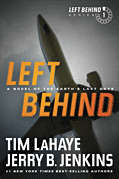
Left Behind Series Review


Introduction

Left Behind"An airborne Boeing 747 is headed to London when, without any warning, passengers mysteriously disappear from their seats. Terror and chaos slowly spread not only through the plane but also worldwide as unusual events continue to unfold. For those who have been left behind, the apocalypse has just begun." --Leftbehind.com

The Left Behind series by Tim LaHaye and Jerry B. Jenkins is possibly one of the most popular Christian fiction series ever written. It begins with the cataclysmic event Christians refer to as The Rapture, follows it into The Tribulation, a period of God's wrath on mankind, and goes all the way to the Glorious Appearing of Christ, all coming together to make twelve books, three prologues, one epilogue, and an entire kids series.

Review

The storyline is good. Character development is good to start out, and the story, following Biblical Eschatology is great. Summed up, the storyline is really a battle between the "Tribulation Saints", the men and women saved through the Tribulation, and the Antichrist, a figure known as Nicolae Jetty Carpathia. So is the storyline perfect? No. In a lot of ways, the story seems to drag on through the twelve books as we wait for different events to happen.

The books are very slow and dry, as is the dialogue. Later in the books, character development weakens as well, and the storyline gets distracted very easily. For example, one woman becomes pregnant with the Antichrist's baby (which, by the way, is against scripture), and she spends three books considering an abortion while her Christian friends try to convince her otherwise. Things like that become huge distractions to the overall plot of the book.

However, these things don't apply to all the books. Nicolae, the third book in the series, has a very good storyline and moves rather quickly, and will turn out to be one of my favorite books I've read all year.

From a family-friendly point of view, take caution. The books are extremely violent. I don't say that to criticize because it's The Tribulation. Beheadings, war and death, death, and more death are part of what the Bible says will unfold during this time. From the very first book, Buck Williams is almost killed in a car bombing, in the third book, World War III breaks out, leading to quite a bit of violence. Public beheadings become a spectacle and may make some readers uncomfortable. There is also some mature content as well, such as abortion. So basically, young readers should take caution.

Now comes the part where, because it's a Christian series based on Biblical events, we have to see if the books match up to scripture, and much to my surprise, they did well. Nothing, besides maybe what I mentioned earlier, goes directly against scripture or against the foundational Christian beliefs. However, there are additions to the Biblical end times plot. For example, one character becomes a kind of "modern day Moses", an addition made simply because some of the plagues in Revelation are similar to the plagues in Egypt, while I find no real Biblical evidence too support that assumption. Unfortunately, I cannot simply let the fact that there are additions pass by me, because in Revelation 22:18 we are given a strong warning not to "add to these words". And unfortunately, Left Behind does.


Conclusion

The Left Behind writers did a lot of things right. They held true to the foundational Christian beliefs, developed a good storyline, and successfully wrote a fiction series that follows thirty years before the Rapture to Kingdom Come. However, there is much that could've been better, as well. Dialogue is dry, many of the books are slow, character development weakens later in the books, and frankly, in some ways, the books are slightly unrealistic at points.

My opinion? Let's just say from now on I'll look elsewhere for good Christian fiction.


Rating

2 out of 5 stars.

Tuesday, November 5, 2013

Welcome to the Show

Some energetic pop music to help you get started today.

Welcome to the Show -- Britt Nicole

Tuesday, October 29, 2013

Sunday, October 20, 2013

Just A Thought -- Persecution

 
Jeremiah is an interesting book. Some find it confusing and hard to get through. While Jeremiah’s prophecies are often hard to understand, there is much in this book that we can take and apply to everyday life.
   
Jeremiah, according to the world’s standards, was a complete failure in his ministry. During the reign of the last few wicked kings of Judah, God told Jeremiah to prophecy of the coming destruction of Jerusalem, calling Judah to repent, while false prophets, mediums and sorcerers prophesied peace and prosperity in the Lord’s name. Jeremiah obeyed God, stood up in public and gave Israel God’s messages. He was put on trial, put in stock, suffered persecution from false prophets, the men from his hometown plotted to assassinate him, and he was imprisoned by King Zedekiah as well (Jeremiah 11, 21, 28, 32). Even after all his work, Judah still went into Babylonian captivity and Jerusalem, along with the Temple, were destroyed. It is really no wonder Jeremiah is called “the weeping prophet”, but even when things got hard, Jeremiah didn’t stop.

While there are many things we can learn from Jeremiah, I’m going to focus on this one. Jeremiah went through a lot of persecution. Did he question God? Absolutely. Did he ever stop trusting God? Never. Jeremiah lived during a time much like the one we’re living in. The world was corrupted with evil, God’s punishment was on the doorstep so to speak, and a couple of God’s prophets, including Jeremiah, were preaching a message of repentance. Likewise, in a world constantly growing darker, we preach a message of repentance and forgiveness of sin and, like Jeremiah, we are persecuted for it.

When we are persecuted, it is easy to become discouraged. So the question is: how do we continue the Lord’s work even in the face of persecution? Well, we can take much from the words of Christ: “I have told you these things, so that in me you may have peace. In this world you will have trouble. But take heart! I have overcome the world.” (John 16:33) Here we are clearly told that although for a moment we may face persecution, the battle has already been won. We are victorious. James 1:2-3 says to “Count it all joy when you fall into various trials, knowing that the testing of your faith produces patience.” Peter says in 1 Peter 4:13, “rejoice to the extent that you partake of Christ’s sufferings, that when His glory is revealed, you may also be glad with exceeding joy.” Paul, in Colossians 1:24, says, “I now rejoice in my sufferings for you, and fill up in my flesh what is lacking in the afflictions of Christ, for the sake of His body, which is the church.” Jesus said in John 15:20, “Remember what I told you: ‘A servant is not greater than his master.’ If they persecuted me, they will persecute you also.”

When we fall into trials, it is so that we may partake in Christ’s sufferings. Becoming a Christian means we are going to be persecuted for our faith, but we can have joy in our trials, because not only does it produce patience for today, it also prepares us for eternal glory with Christ.

To all the children of God let’s, like Jeremiah, continue to give our message to the world. And to the world I say bring it on.